
Which CRM Should a Real Estate Developer in Panama Use?
68 of the 98 developers in the study run without a CRM. Which system to choose, what it really costs, and how to implement it without slowing sales.

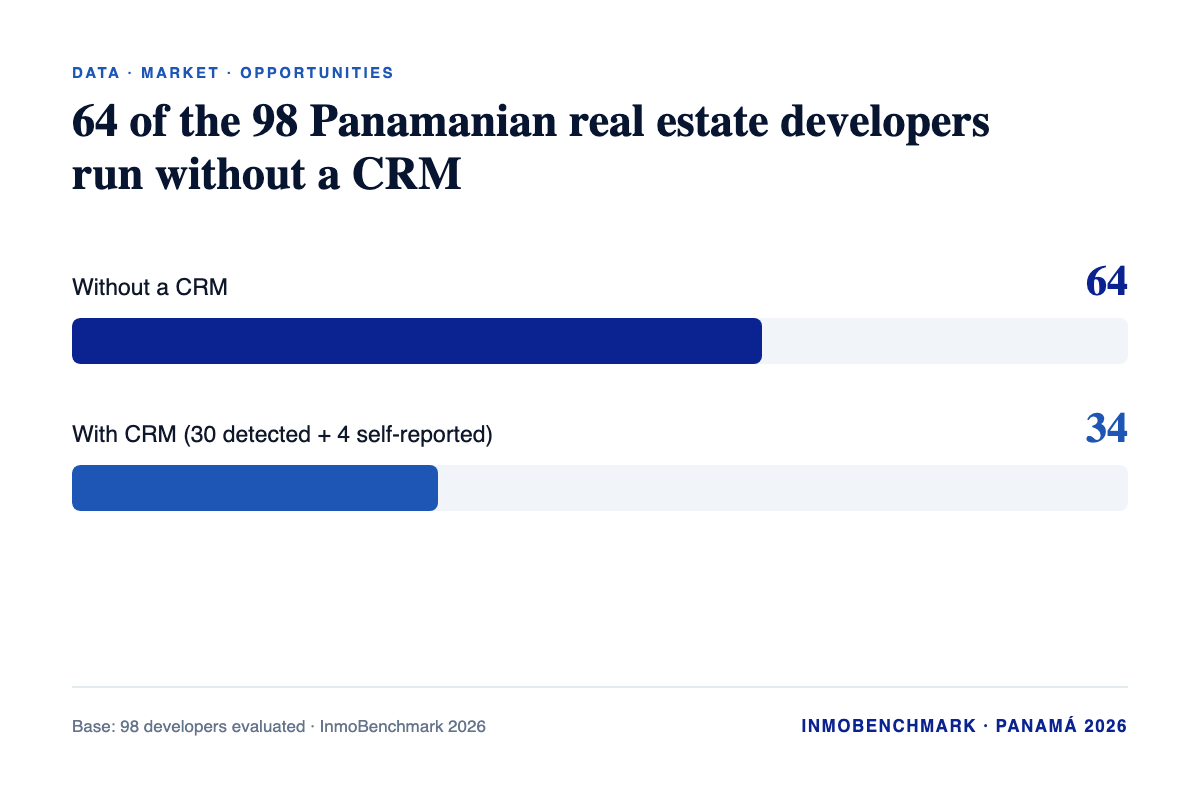
When we asked the sales teams of the 98 real estate developers in Panama we studied, the same scene repeats: leads live in spreadsheets, in salespeople's phones, and in the memory of whoever answered. It is why 60 of those 98 developers run without a CRM. This guide answers which CRM a real estate developer in Panama should use and, above all, how to take the first step without slowing down sales.
Key facts about CRMs in the Panamanian market
- •60 of the 98 developers in the study do not use a CRM; 38 do — 34 with a CRM detected on their website and 4 self-reported — 4.
- •Commercial Maturity averages 29.4 out of 100, the lowest of the ten criteria evaluated 4.
- •97% of developers have forms on their website: the problem is not capturing, it is what happens next 4.
- •The one-hour rule: leads handled within the first hour close twice as often as those handled after a day 1.
- •Serious free-plan CRMs exist, including HubSpot and Zoho 2 3.
Why do 60 of 98 developers in Panama run without a CRM?
Because the sector grew faster than its processes. With the demand seen in 2026, a team can sell with just WhatsApp and a spreadsheet. The problem appears when volume rises: without a system, every lead depends on one person's memory and follow-ups get lost.
It is not a budget problem. The most widely used CRMs have free plans that are enough for a small team 2 3. It is a habit problem: while the team sells from their phones, no system gets adopted on its own. The good news is the solution does not require changing how you sell, only recording what you already know.
What should a CRM do in a real estate developer?
Five things: keep every lead in one place, say who should answer, measure how long the response takes, warn when a follow-up is about to expire, and show, every week, how many leads came in and how many reached a viewing. Everything else is optional.
- One place. The same lead cannot exist in three different spreadsheets. 4
- A clear owner. Every lead has a responsible name from minute zero.
- Visible response time. If it is not measured, the first hour is lost without anyone noticing. 1
- Follow-up with a date. "Call next week" is not a date.
- A short weekly report. New leads, first response, viewings booked.
How much does not having a CRM cost?
It costs the leads that go cold. In a benchmark of 939 B2B companies with CRM data (2026), leads handled within the first hour closed twice as often as those handled after a day 1. A lead from a fair or a portal that waits until tomorrow rarely answers the same way.
In our work with Panamanian developers we see the same: the team that answers in minutes converts more than the team that answers the next day, with the same volume of leads. The CRM does not create that discipline, but it makes it visible, and what is visible can be improved.
Want to know how your team compares with the market? Request your free report.
Request reportWhich CRM should a real estate developer in Panama use?
The one your team will actually use every day. For most Panamanian developers that means starting with a free-plan CRM (HubSpot and Zoho are solid options) and using it fully before paying for something bigger 2 3. The right tool is the one that records, measures, and reminds without getting in the way.
A free plan covers the basics and is enough to start. A paid subscription becomes important when the developer starts to scale: new salespeople are onboarded and marketing, sales and after-sales departments are established, and each one needs to see the same thing about every lead. That is the natural transition: first the habit with a free plan, then the system that supports the whole team.
Before choosing, ask the vendor three questions: does it connect to your website forms and WhatsApp? Can you see first-response time? Can your team use it from a phone? If any answer is no, keep looking. The rest (dashboards, AI, automations) matters later, not in the first month.
How do you implement a CRM without slowing down sales?
In two weeks and with a single rule: from day one, every new lead enters the system. Do not migrate all history, change pricing, or redesign processes. Start by recording what comes in this week, review the dashboard each morning, and let the habit hold itself up.
Before implementing, put your processes in order and test the waters with a CRM: a system without adaptation or training for the team is a waste of time, energy and money, and only creates frustration. The tool comes when the process is already clear.
- Week 1: connect the website forms and create one field set per lead (name, project of interest, follow-up date).
- Week 2: add WhatsApp and measure first-response time. Review the number in Monday's meeting.
- Month 2: only then think about automations, sequences, and extended reporting.
What should the team measure every week?
Four numbers: new leads, first-response time, follow-ups completed, and viewings booked. If these four are reviewed every week, the team knows where it is losing leads without needing a complicated dashboard.
| Metric | What it answers | Recommended target |
|---|---|---|
| New leads | Are people coming in? | According to your marketing spend |
| First-response time | Are leads answered on time? | Under 1 hour 1 |
| Follow-ups completed | Is everyone who wrote being looked after? | 100% of due follow-ups |
| Viewings booked | Do leads turn into viewings? | Rising trend month over month |
The targets are practical recommendations based on our work with developers; they are not benchmark data.Unverified finding
Cited sources
- [1] Optifai (2026). "Lead Response Time Benchmarks: 939 Companies." CRM data from 939 B2B companies (Q2 2025 - Q1 2026): leads handled within the first hour close twice as often as those handled after a day (24% vs 12%). https://optif.ai/learn/questions/lead-response-time-benchmark/
- [2] HubSpot: CRM pricing page (free plan available). Consulted October 12, 2026. https://www.hubspot.com/pricing/crm
- [3] Zoho CRM: pricing page (free plan available). Consulted October 12, 2026. https://www.zoho.com/crm/pricing.html
- [4] InmoBenchmark, digital benchmark of Panama's 98 real estate developers. Data consulted October 12, 2026. https://inmobenchmark.com/
Honesty note: InmoBenchmark receives no compensation from the CRM vendors mentioned. The cited options are included because they have publicly verifiable plans.
See how your project compares with the other 98 developers in the market.
Frequently asked questions
How many real estate developers in Panama use a CRM?
According to the InmoBenchmark study of 98 developers, 34 have a detected CRM and 60 run without one. Commercial Maturity, which measures lead follow-up among other things, averages 29.4 out of 100: the lowest of the ten criteria evaluated. Most leads still live in spreadsheets and phones.
What is the best CRM for a real estate developer in Panama?
The one the team uses daily. For most developers, starting with a free-plan CRM such as HubSpot or Zoho, connected to website forms and with measured follow-up, covers most of the need before investing in anything bigger. The right tool records, measures and reminds without getting in the way of selling.
Can a developer run on WhatsApp and spreadsheets alone?
Yes, while volume is low. The problem appears when it rises: without a system, follow-ups depend on each salesperson's memory and leads go cold. The first hour of response makes the difference. As the team and the number of leads grow, that habit stops scaling.
How much does it cost to implement a CRM in a developer?
The software can cost nothing: the most widely used CRMs have free plans. The real cost is habit: two weeks to connect forms, record every new lead, and review response time each morning. Budget also for training the team: a system without adaptation is a waste of money.
What should each salesperson record per lead?
The minimum: name, project of interest, source channel, date of last contact, and date of next follow-up. With those five fields, a team can answer any lead without depending on memory. Everything else is optional and can be added later, once the habit holds.
How do I know the CRM is working?
Measure four numbers weekly: new leads, first-response time, follow-ups completed, and viewings booked. If first-response time drops and viewings rise, the system is working. If those four numbers are reviewed every week, the team knows where it is losing leads without a complicated dashboard.
About the author
Martijn Van Dooren
Founder of InmoBenchmark and real estate digital strategy advisor
Martijn Van Dooren is the creator of InmoBenchmark, the digital benchmark of Panama's 98 real estate developers, and a digital strategy advisor for the industry. He works with developers on lead capture, response times, and the real use of WhatsApp and email inside sales teams.
Developers in this analysis
Full profiles of the developers in these segments, ranked by score.