
How Much ITBI Do You Pay on a New Home in Panama?
Panama ITBI 2026: the first sale of a new home pays no tax on the first B/.120,000 of the base. Rates, worked examples and deadlines under Law 546.

Updated November 22, 2026 · Martijn van Dooren, InmoBenchmark
How much ITBI do you pay on a new home in Panama in 2026?
In 2026, the first sale of a new home pays zero ITBI on the first B/.120,000 of the taxable base, and a preferential rate of 0.50% to 1.80% up to B/.200,000. Above that, the first B/.120,000 stay exempt and the rest pays the general 2%. The deed must be formalized within two years of the occupancy permit 1 3.
The rule comes from Law 546 of August 31, 2026, in force since September 1, 2026, which amends Article 4 of Law 106 of 1974. The real estate transfer tax (ITBI) is 2%, and in the eyes of the tax authority it is paid by the seller. Its taxable base is the higher of the value stated in the deed and the cadastral value of the property, plus improvements and an accumulated 5% annual adjustment 5 8.
This article answers the question with illustrative calculations, the dates that decide the benefit, and the filing the seller must complete. It applies to the first sale of a new home; any resale pays the general regime without exception. Balboas (B/.) are pegged one to one with the US dollar.
How is ITBI calculated if the home exceeds B/.120,000?
The preferential scale applies only to the excess above B/.120,000, and the rate is set by the bracket the total taxable base falls into. It is not an accumulation of brackets: if the total base lands in one bracket, that rate applies to the entire excess 1 2 7.
| Taxable base | Rate applied to the excess over B/.120,000 |
|---|---|
| Up to B/.120,000 | Exempt (0%) |
| Over 120,000 up to 130,000 | 0.50% |
| Over 130,000 up to 150,000 | 1.00% |
| Over 150,000 up to 170,000 | 1.40% |
| Over 170,000 up to 190,000 | 1.60% |
| Over 190,000 up to 200,000 | 1.80% |
| Over 200,000 | General regime (2%) on the excess; the first B/.120,000 remain exempt |
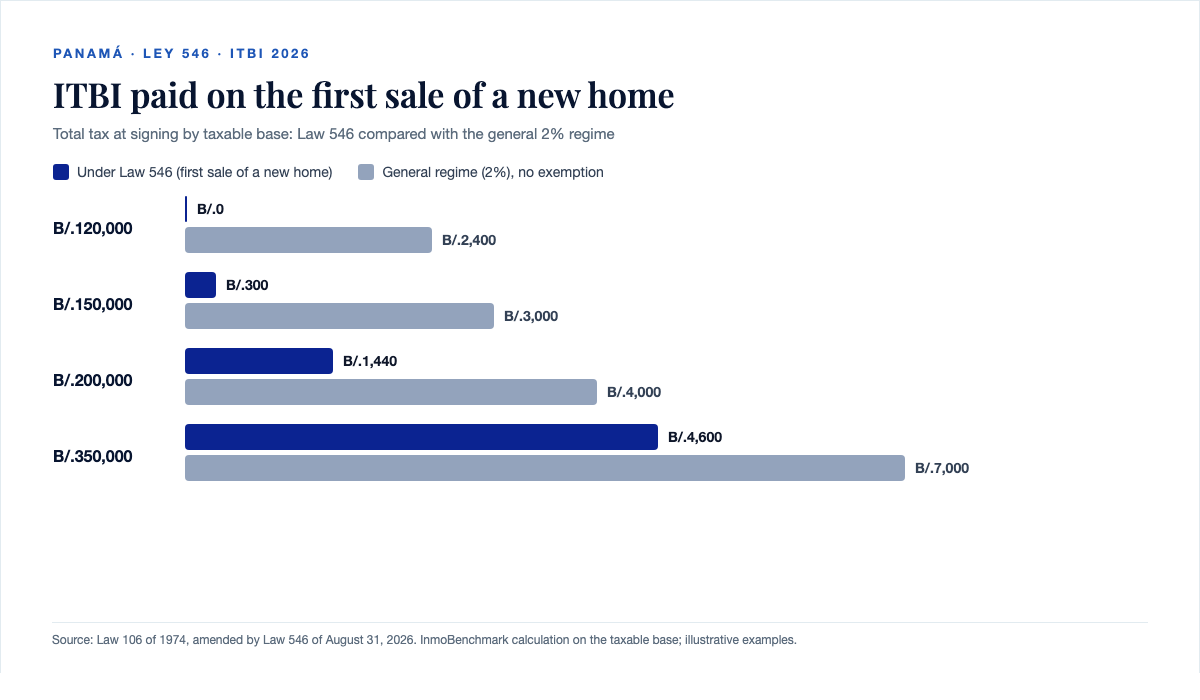
Illustrative examples on the taxable base of a first sale of a new home under Law 546 (InmoBenchmark calculation):
| Taxable base | ITBI under Law 546 | ITBI under the general regime (2%) | Saving |
|---|---|---|---|
| B/.120,000 | B/.0 | B/.2,400 | B/.2,400 |
| B/.150,000 | B/.300 (30,000 at 1.00%) | B/.3,000 | B/.2,700 |
| B/.190,000 | B/.1,120 (70,000 at 1.60%) | B/.3,800 | B/.2,680 |
| B/.200,000 | B/.1,440 (80,000 at 1.80%) | B/.4,000 | B/.2,560 |
| B/.350,000 | B/.4,600 (230,000 at 2%) | B/.7,000 | B/.2,400 |
One practical warning: the taxable base is not always the advertised price. The law requires the tax to be calculated on the higher of the deed value and the adjusted cadastral value, so a list price can fall below the real base 5 7 8.
How much does the buyer save under Law 546?
First, a clarification: the taxpayer is the seller, not the buyer 5 8. The saving below is the smaller tax bill at signing; in practice that benefit usually reaches the buyer, but the legal obligation stays with the seller. The maximum saving is B/.2,700, reached with bases between B/.150,000 and B/.170,000. Above B/.200,000 the saving settles at B/.2,400, because what stays exempt is always the same B/.120,000 slice calculated at 2% 3 7.
The benefit does not reduce the sale price and does not change the cadastral base: it reduces what is paid at signing. In a cash purchase it is a direct discount; in a financed purchase the bank typically funds the price and the tax is settled separately at closing, so the smaller tax bill shows up at closing; who keeps the benefit depends on what the parties agree in the contract.
What happens if the occupancy permit predates Law 546?
The two dates that govern are the issuance of the occupancy permit and the formalization of the sale. If the permit was issued during the validity of Law 546, the sale has two years from that permit to be formalized. If the permit predates September 1, 2026, the transitional provision allows the benefit as long as the sale is formalized within 30 months of the permit date 1 2 6.
Sales formalized before September 1, 2026 remain under the regime in force at that time. For projects delivering this year, the occupancy permit date is the fact worth checking unit by unit: it decides whether the signing falls inside or outside the window 2.
Who pays ITBI in Panama, the buyer or the seller?
In the eyes of the tax authority, the taxpayer is the transferor, meaning the seller. The notary cannot execute the deed without proof of payment, and the Public Registry will not register the transfer without it 5 8.
In practice, the contract sets out who funds the tax, and that clause organizes the closing. The new exception matters for developers: in transactions under Law 546, any clause imposing on the buyer the payment, reimbursement or assumption of the ITBI legally owed by the seller is void by operation of law 1 2 8.
What happens with a resale or a used property?
A resale, meaning any second sale of a used home, does not qualify for Law 546: it pays the general 2% regime on the taxable base, calculated under the same higher-of-deed-or-cadastral rule 5 7.
In addition to the 2% ITBI, an occasional sale can trigger a capital gains advance payment of 3%, declared on a separate form. They are two separate obligations with two forms: 106 for ITBI and 107 for the advance 8.
What must the seller do to apply the exemption?
The exemption does not require a prior certification from the Directorate of Revenue (DGI). It is replaced by a sworn statement from the seller in the public deed, under penalty of perjury, that the property is a new home, that the operation is its first sale, and that the sale is formalized within the legal deadline, stating the date and identifying details of the occupancy permit 1 2.
The benefit must still be reported to the DGI through the forms or electronic channels it establishes, for registration and audit purposes. The tax return and payment fall in the same calendar month as the transfer, on Form 106 6 8.
If the statement is false or the benefit is applied improperly, the unpaid tax is collected with surcharges and interest, without prejudice to any administrative, civil or criminal penalties 1 2.
What changed in 2026 and what should a developer check now?
The timeline is short and already passed through three changes: Law 399 of 2023 set an end date for the previous exemption, Law 468 of April 2025 repealed the relevant article of Law 106 of 1974, and Law 472 of June 2025 suspended that repeal until December 31, 2025. On January 1, 2026 the previous benefit ended, and for eight months the first purchase of a new home paid the full ITBI. Law 546 restored a more targeted benefit on September 1, 2026 3 4.
For a developer, four checks are worth more than any strategy:
- Verify the occupancy permit date of every unit on sale and calculate the signing window (two years, or 30 months if the permit predates September 2026).
- Correct the contracts: no clause may shift to the buyer the ITBI owed by the seller in transactions under the benefit.
- Put the benefit where the buyer reads it: project fact sheet, landing page, quick WhatsApp reply and sales team training 9.
- Align price and base: if the cadastral value exceeds the advertised price, the published saving is not the real saving.
What do buyers ask when they ask AI?
A growing share of purchase research starts in an AI assistant, and the questions are specific: how much does it cost to buy, who pays the tax, how much does the new law save. We run periodic checks of what those assistants answer about the Panamanian real estate market: which names appear, which sources they cite, and who they leave out 10.
The same method we use in the study applies here. The questions buyers ask engines such as ChatGPT, Gemini, Perplexity and Google AI Overviews can be listed, measured and compared against three named competitors. Nobody can guarantee placement inside an AI assistant; what you can do is measure the answer today, fix the question list, and re-measure at 60 and 90 days 11.
Your next buyer asked AI who to buy from in Panama. AI named someone else. You can see who it names, and which sources it cites, at no cost: we offer an AI visibility scorecard with your segment's questions, your mention rate against three competitors, and three quick wins you can apply the same week.
Request the AI visibility scorecard · Request a diagnostic
The study's summary is in What the webinar revealed about the digital state of real estate in Panama, and the detail of the ten evaluation criteria is in Methodology.
References
- EY Central America: "Panama reinstates tax benefits applicable to the first sale of new homes", September 2, 2026.
- Dentons: "New homes in Panama: a new opportunity to reduce the Real Estate Transfer Tax (ITBI)", September 3, 2026.
- La Prensa: "President signs Law exempting ITBI on the purchase of new homes up to $120 thousand", August 31, 2026.
- Ministry of Economy and Finance of Panama: "President Mulino signs Law exempting the 2% ITBI to facilitate access to housing", August 2026.
- Law 106 of 1974, Articles 1 and 4, consolidated text (amended by Law 6 of 2005 and Law 399 of 2023).
- Directorate of Revenue: instructions for Form F-106, version 4 updated 2026.
- Legal500: "Panama Property Transfer Tax Exemption For New Homes: How Law 546 Works", November 6, 2026.
- Quiros & Quiros: "Taxes when selling property in Panama: 2% and 3%", September 19, 2026.
- InmoBenchmark: "Expo CAPAC 2026: housing demand in numbers", September 2026.
- InmoBenchmark: weekly AI visibility runs across 13 market questions, November 2026.
- WX Partners: Offer Model, November 2026 (fixed question list, measurements at day 60 and day 90).
Frequently asked questions
When does the ITBI exemption apply to a first new home?
It applies to the first sale operation of a new home, formalized within two years of the issuance of the occupancy permit. For permits issued before September 1, 2026, the transitional provision allows 30 months from the permit date. The exemption covers the first B/.120,000 of the taxable base 1 2 6.
How is ITBI calculated if the home exceeds B/.120,000?
The tax is calculated only on the excess, at the rate of the bracket the total taxable base falls into: 0.50% up to B/.130,000, 1.00% up to B/.150,000, 1.40% up to B/.170,000, 1.60% up to B/.190,000 and 1.80% up to B/.200,000. On bases above B/.200,000, the first B/.120,000 are exempt and the rest pays the general 2% 1 2 3.
What happens if the occupancy permit predates Law 546?
You can still claim the benefit if the sale is formalized within 30 months of the permit's issuance. For permits issued during the law's validity, the window is two years from the permit. Sales formalized before September 1, 2026 follow the previous regime, without the Law 546 exemption 1 2.
How much do you really save under Law 546?
On an example with a taxable base of B/.150,000, the saving is B/.2,700: instead of B/.3,000 at 2%, you pay B/.300 at 1.00% on the excess. With bases of B/.200,000 or more, the saving holds at B/.2,400, equal to the exemption on the first B/.120,000. These are illustrative calculations: the real taxable base can exceed the advertised price 3 7 8.
Who declares the benefit and to whom?
The seller declares the benefit under oath in the public deed, with no prior DGI certification required. The DGI must be notified through the forms or channels it establishes, for registration and audit purposes, and the tax return is filed on Form 106 in the same calendar month as the transfer 1 2 6.
Who pays ITBI in Panama, the buyer or the seller?
The taxpayer before the tax authority is the seller: without proof of payment in the deed, the notary cannot execute the contract and the Public Registry will not register the transfer. Between the parties, the contract may allocate who funds the tax, but in transactions under Law 546 any clause shifting the tax to the buyer is void by operation of law 1 5 8.
About the author
Martijn Van Dooren
Founder of InmoBenchmark and real estate digital strategy advisor
Martijn Van Dooren is the creator of InmoBenchmark, the digital benchmark of Panama's 98 real estate developers, and a digital strategy advisor for the industry. He works with developers on lead capture, response times, and the real use of WhatsApp and email inside sales teams.